
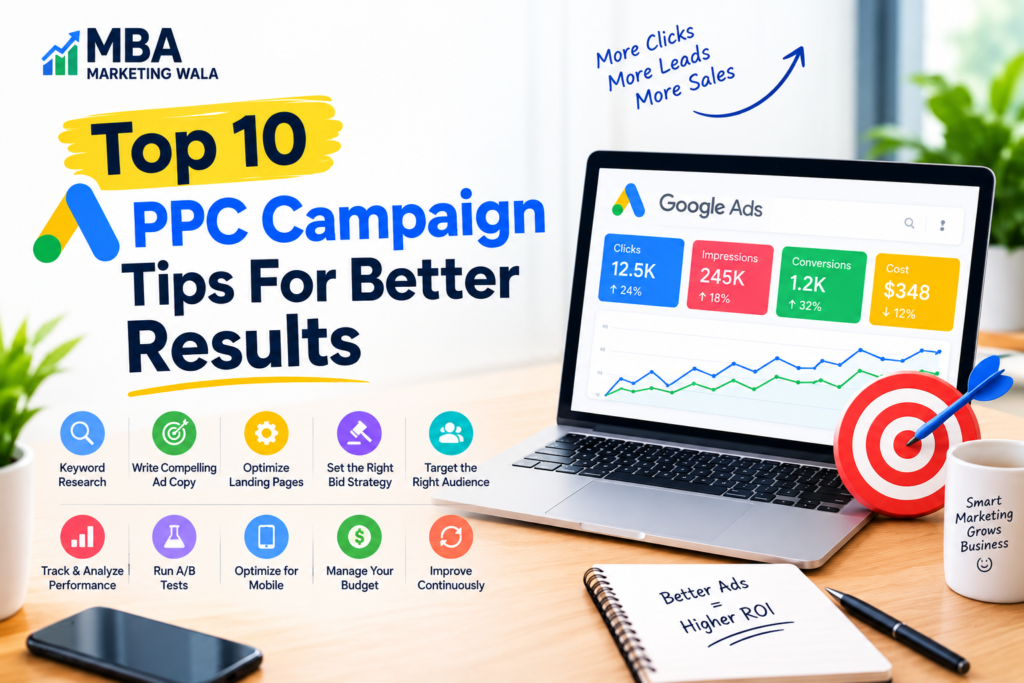
Pay-per-click (PPC) advertising is one of the most widely used forms of digital advertising. It allows businesses to promote their products and services online and reach potential customers through platforms such as Google Ads and other advertising networks.
However, simply launching a PPC campaign does not guarantee good results. A successful PPC campaign requires proper planning, relevant targeting, effective ad copy, appropriate keywords, optimized landing pages, and regular performance analysis.
For startups, small businesses, and established companies, understanding the right PPC campaign tips can help create more focused advertising campaigns and make better use of an available marketing budget.
In this blog, we will explore the top 10 PPC campaign tips for better results and explain how businesses can improve their paid advertising strategy.
What Is a PPC Campaign?
PPC stands for Pay-Per-Click. It is an online advertising model where advertisers typically pay when someone interacts with an advertisement according to the platform’s pricing model.
One common example is Google Search advertising. When users search for products or services, relevant paid advertisements may appear alongside organic search results.
Businesses can use PPC campaigns for different objectives, including:
- Website traffic
- Lead generation
- Online sales
- Product promotion
- Service inquiries
- Brand awareness
- App promotion
The right campaign structure depends on your business objective and advertising platform.
1. Define a Clear PPC Campaign Goal
Before creating a PPC campaign, determine exactly what you want the campaign to achieve.
Your objective could be:
- Generate leads
- Increase sales
- Get phone calls
- Drive website traffic
- Promote a product
- Generate registrations
- Increase inquiries
For example, if you run a digital marketing course, your PPC campaign could focus on generating inquiries from people interested in digital marketing training.
A clear goal helps determine:
- Campaign setup
- Target audience
- Ad messaging
- Landing page
- Conversion tracking
- Performance metrics
Avoid launching campaigns without knowing what success means for your business.
2. Research and Select Relevant Keywords
For Search PPC campaigns, keyword research is an important step.
Keywords are the words or phrases that people use when searching for information, products, or services.
For example, a digital marketing training business might research keywords such as:
- Digital marketing course
- Digital marketing classes
- Digital marketing training
- SEO course
- Google Ads course
- Social media marketing course
The keywords you select should be closely related to what your business actually offers.
Consider Search Intent
Search intent helps you understand what a person is trying to accomplish with a search.
For example:
“What is digital marketing?”
is generally informational.
While:
“Digital marketing course near me”
may indicate stronger commercial intent.
Understanding intent can help businesses create more relevant campaigns and advertisements.
3. Use Negative Keywords Carefully
One of the most useful PPC campaign tips is to review search terms and use negative keywords where appropriate.
Negative keywords can help prevent your ads from appearing for searches that are not relevant to your business.
For example, if a business offers paid digital marketing training but does not offer free courses, searches containing “free” might not be relevant.
Adding appropriate negative keywords can help reduce unwanted traffic.
However, negative keyword lists should be created carefully. Overly broad exclusions could prevent potentially useful searches from triggering your advertisements.
Regularly Review Search Terms
Search-term reports can help businesses identify:
- Irrelevant searches
- New keyword opportunities
- Customer language
- Potential negative keywords
This makes search-term analysis an important part of ongoing PPC optimization.
4. Write Relevant and Clear Ad Copy
Your advertisement is often the first interaction a potential customer has with your business.
Good ad copy should clearly communicate:
- What you offer
- Who it is for
- Relevant benefits
- What users can do next
For example:
Digital Marketing Training
Learn SEO, Social Media & Google Ads
Explore Course Details
The advertisement should accurately represent your actual offer.
Avoid exaggerated claims, misleading statements, or information that cannot be supported.
Match Your Ad to Search Intent
If someone searches for “SEO course,” an advertisement focused specifically on SEO training may be more relevant than a generic advertisement for all digital marketing services.
Relevant messaging can help create a more consistent user experience.
5. Create a High-Quality Landing Page
Getting clicks is only part of a PPC campaign.
After clicking your advertisement, users should arrive at a landing page that clearly relates to the advertisement.
For example:
Ad: Google Ads Course
Landing Page: Google Ads Course Information
A relevant landing page can include:
- Clear headline
- Product or service information
- Key features
- Benefits
- Images
- FAQs
- Contact information
- Clear call-to-action
The landing page should also be easy to navigate and work properly on mobile devices.
Avoid Sending Every Ad to Your Homepage
A homepage may contain information about many different products or services.
For specific campaigns, a dedicated landing page can provide a more focused experience.
6. Set the Right Geographic Targeting
Location targeting is particularly important for local businesses.
If your business serves customers in a specific city or region, you can structure your campaign around the locations you actually serve.
For example, a local digital marketing class could focus on relevant searches from its service area.
Depending on your business, you may target:
- Cities
- Regions
- States
- Countries
- Specific geographic areas
Location targeting should reflect your actual business coverage.
For example, a local business operating in Nagpur may not need to target customers across India if it only serves customers locally.
7. Track Conversions
Conversion tracking is one of the most important PPC campaign tips for better results.
Clicks and impressions tell you how people interact with your advertisements, but conversions can provide information about whether users are taking the actions that matter to your business.
Possible conversions include:
- Form submissions
- Purchases
- Phone calls
- Registrations
- Bookings
- Course inquiries
- Sign-ups
For example, if your campaign receives 500 clicks but generates no meaningful inquiries, you need to investigate the campaign rather than simply increasing the budget.
Conversion tracking helps connect advertising activity with business outcomes.
8. Monitor Important PPC Metrics
PPC campaigns generate a large amount of performance data.
Some useful metrics include:
Impressions
The number of times an advertisement was shown.
Clicks
The number of times users clicked an advertisement.
Click-Through Rate (CTR)
CTR helps measure how frequently users click after seeing an advertisement.
Cost Per Click (CPC)
CPC indicates the amount associated with each click under the platform’s applicable pricing model.
Conversions
The number of tracked desired actions.
Conversion Rate
The percentage of relevant interactions that resulted in a tracked conversion.
Cost Per Conversion
The advertising cost associated with generating a conversion.
The most useful metrics depend on the campaign’s objective.
9. Test and Optimize Your Campaign
A PPC campaign should be monitored regularly instead of being launched and forgotten.
Businesses can test different elements such as:
- Ad headlines
- Ad descriptions
- Keywords
- Landing pages
- Calls-to-action
- Geographic targeting
- Audience settings
- Campaign structures
Testing can help you understand which approaches perform better for your specific audience.
However, avoid changing everything at once. Making structured changes can make it easier to understand what affected performance.
Example
Suppose two advertisements promote the same service but use different messaging.
After collecting sufficient data, you can compare their relevant performance metrics and use those insights to guide future advertising decisions.
10. Optimize Your PPC Budget
Budget management is another essential part of PPC advertising.
You should decide how much you are comfortable spending based on:
- Business goals
- Customer value
- Competition
- Campaign performance
- Target location
- Available marketing budget
Start with a controlled budget and monitor results.
If a campaign performs differently from your expectations, investigate the reasons before simply increasing spending.
Similarly, do not assume that reducing a budget will automatically improve efficiency.
Budget decisions should be based on campaign data and business objectives.
PPC Campaign Optimization Checklist
Before launching your campaign, review the following:
✅ Clear campaign objective
✅ Relevant keyword research
✅ Appropriate negative keywords
✅ Relevant ad copy
✅ Strong landing page
✅ Correct location targeting
✅ Conversion tracking
✅ Mobile-friendly destination page
✅ Performance monitoring
✅ Regular optimization
This simple checklist can help businesses identify important areas before and after launching a PPC campaign.
Common PPC Mistakes Businesses Should Avoid
1. Using Irrelevant Keywords
Keywords should match your actual products or services.
2. Ignoring Search Terms
Search-term analysis can reveal irrelevant searches and new opportunities.
3. Sending All Traffic to the Homepage
Specific campaigns may benefit from more relevant landing pages.
4. Not Tracking Conversions
Without conversion tracking, it becomes difficult to understand whether your campaign is achieving its business objective.
5. Making Unsupported Claims
Advertisements should accurately represent your products, services, and offers.
6. Focusing Only on Clicks
A high number of clicks does not necessarily mean a campaign is achieving its business goal.
7. Never Optimizing the Campaign
PPC performance can change over time. Regular monitoring and optimization are important.