
Starting a new business is exciting, but getting your brand noticed can be challenging. Startups often have limited budgets, small teams, and strong competition. This is where social media marketing for startups can make a significant difference.
Social media platforms allow startups to introduce their brand, connect with potential customers, share valuable content, and build relationships with their target audience. However, simply creating an Instagram or Facebook account is not enough. Startups need a clear strategy to use social media effectively.
In this blog, we will discuss the top 7 social media strategies for startups that can help new businesses build their online presence, increase engagement, and create long-term brand awareness.
What Is Social Media Marketing for Startups?
Social media marketing involves using platforms such as Instagram, Facebook, LinkedIn, YouTube, and other social networks to promote a business and communicate with its audience.
For startups, social media can be used to:
- Build brand awareness
- Reach potential customers
- Share educational content
- Generate website traffic
- Build a community
- Showcase products or services
- Collect customer feedback
- Support lead generation
A successful social media strategy focuses on reaching the right audience with the right content at the right time.
1. Define Your Target Audience
One of the first social media strategies for startups is understanding your target audience.
Before creating content, identify who you want to reach.
Consider factors such as:
- Age
- Location
- Interests
- Profession
- Problems and needs
- Buying behavior
- Preferred social media platforms
For example, a startup selling professional services to business owners may focus more heavily on LinkedIn, while a fashion or food startup may find visual platforms more relevant.
Understanding your audience helps you create content that is more relevant to the people you want to reach.
Create a Simple Customer Profile
You can create a basic customer profile by answering:
Who are they?
What problem do they have?
What solution does my startup provide?
Which platforms do they use?
What type of content do they consume?
The clearer your audience is, the easier it becomes to plan your social media content.
2. Choose the Right Social Media Platforms
Startups do not necessarily need to be active on every social media platform.
Managing multiple platforms requires time, creativity, and consistency. Instead, choose platforms based on your target audience and business goals.
Some commonly used platforms include:
Instagram can be useful for visual content such as:
- Reels
- Photos
- Stories
- Carousels
- Product demonstrations
- Behind-the-scenes content
Facebook can help businesses build communities, share updates, promote content, and communicate with customers.
LinkedIn can be particularly useful for B2B startups, professional services, recruitment, and thought leadership.
YouTube
YouTube can be useful for educational videos, tutorials, product demonstrations, reviews, and long-form content.
X
X can be useful for conversations, updates, industry discussions, and real-time communication, depending on the audience.
Tip: Start with one or two platforms where your target customers are most active rather than spreading your resources too thinly.
3. Create Valuable and Consistent Content
Content is at the center of social media marketing.
One of the most important social media strategies for startups is to create content that provides value instead of constantly promoting products or services.
Your content can educate, entertain, inspire, or inform your audience.
For example, a digital marketing startup could create:
- SEO tips
- Social media tips
- Google Ads tips
- Marketing tutorials
- Industry news
- Case studies
- Marketing mistakes to avoid
- Beginner guides
Use Different Content Formats
Avoid publishing the same type of post every day.
Experiment with:
- Reels
- Carousels
- Images
- Stories
- Short videos
- Infographics
- Polls
- Questions
- Educational posts
Different formats can help you understand what your audience responds to.
Follow a Content Calendar
A simple content calendar can help you plan your posts in advance.
For example:
| Day | Content Type |
|---|---|
| Monday | Educational Post |
| Tuesday | Reel |
| Wednesday | Industry Tip |
| Thursday | Carousel |
| Friday | Behind-the-Scenes |
| Saturday | Customer/Community Content |
| Sunday | FAQ or Engagement Post |
The exact schedule can be adjusted according to your business and audience.
4. Focus on Short-Form Video and Reels
Short-form video has become an important content format for many social media marketers.
Platforms such as Instagram, Facebook, and YouTube support short-form video content.
Startups can use short videos to:
- Explain products
- Answer common questions
- Share quick tips
- Show behind-the-scenes content
- Demonstrate products
- Introduce team members
- Share educational information
- Participate in relevant trends
For example, a startup offering digital marketing training could create a short video titled:
“3 SEO Mistakes Beginners Should Avoid.”
Another video could be:
“5 Digital Marketing Skills You Can Learn in 2026.”
The goal should be to provide useful or interesting information rather than simply following every trend.
Keep the First Few Seconds Interesting
For short-form content, the opening is important.
You could begin with a question:
“Are you making these SEO mistakes?”
Or a direct statement:
“Here are 3 social media mistakes startups should avoid.”
Then quickly deliver the useful information.
5. Build Engagement and Community
Social media is not only about publishing content. It is also about communication.
Startups should actively engage with their audience.
You can:
- Reply to comments
- Answer direct messages
- Respond to questions
- Ask questions in captions
- Create polls
- Share customer feedback
- Encourage discussions
- Respond to relevant mentions
For example, instead of ending every post with a promotional message, ask:
“Which digital marketing skill do you want to learn first?”
This can encourage people to interact with your content.
Why Community Matters
People are more likely to remember brands that communicate with them consistently.
A startup that builds an engaged community can create relationships that go beyond individual social media posts.
6. Use Social Media Analytics
Another important social media strategy for startups is tracking performance.
Most major social media platforms provide analytics or insights that can help businesses understand how their content is performing.
You can monitor metrics such as:
- Reach
- Impressions
- Engagement
- Likes
- Comments
- Shares
- Saves
- Video views
- Profile visits
- Website clicks
- Follower growth
However, do not focus only on follower numbers.
For example, a post with a smaller reach but strong engagement may provide useful information about what your audience values.
Learn From Your Data
Ask questions such as:
- Which posts received the most engagement?
- Which videos received more views?
- Which topics generated comments?
- Which content received more saves?
- Which posts generated website visits?
Use these observations to improve future content.
7. Combine Organic Content With Paid Advertising
Organic social media can help startups build their presence, but paid advertising can provide another way to reach specific audiences.
Platforms such as Facebook and Instagram allow businesses to create advertising campaigns based on different objectives and targeting options.
Depending on the business, startups may use paid social advertising to:
- Promote products
- Generate leads
- Drive website traffic
- Increase awareness
- Promote an event
- Encourage inquiries
- Support sales
However, paid advertising should be planned carefully.
Before running an advertisement, make sure you have:
- A clear objective
- Relevant audience targeting
- Strong creative
- Clear messaging
- Appropriate landing page or destination
- Conversion measurement where applicable
Start with a controlled budget, monitor results, and make changes based on data.
Bonus Tips for Social Media Success
The seven strategies above can help startups establish a foundation, but a few additional practices can make your social media efforts more organized.
Maintain Brand Consistency
Use consistent:
- Logo
- Brand colors
- Fonts
- Visual style
- Tone of voice
This helps people recognize your startup across different platforms.
Create a Strong Profile
Your social media profile should clearly explain:
Who you are + What you offer + Who you help + What users should do next.
Include a relevant profile image, concise bio, website link, and contact information where appropriate.
Avoid Constant Promotion
If every post asks users to buy something, your audience may lose interest.
Instead, create a healthy mix of:
- Educational content
- Entertaining content
- Community content
- Promotional content
Be Consistent
You do not need to publish dozens of posts every day.
A realistic and sustainable posting schedule is generally more useful than creating a large amount of content for a short period and then stopping.
Common Social Media Mistakes Startups Should Avoid
1. Posting Without a Strategy
Random posts without a clear objective can make it difficult to build a consistent brand.
2. Trying Every Platform
Managing too many platforms can reduce content quality and consistency.
3. Ignoring Comments and Messages
Social media is a two-way communication channel. Ignoring your audience can reduce engagement opportunities.
4. Copying Competitors
Competitor research can provide ideas, but startups should develop their own brand identity and content approach.
5. Focusing Only on Followers
A large follower count does not automatically mean successful marketing. Engagement, website actions, leads, and other business-relevant metrics may also matter.
6. Not Reviewing Analytics
Without performance data, it becomes harder to identify what content is working and what needs improvement.
Benefits of Social Media Marketing for Startups
A well-planned social media strategy can help startups:
- Build brand awareness
- Connect with potential customers
- Develop a community
- Showcase expertise
- Share valuable information
- Generate website traffic
- Support lead generation
- Collect customer feedback
- Strengthen online visibility
The actual results will depend on the startup’s industry, audience, content quality, consistency, competition, budget, and overall marketing strategy.
Final Thoughts
Building a successful social media presence takes time. Startups should focus on creating a clear strategy rather than trying to achieve immediate results.
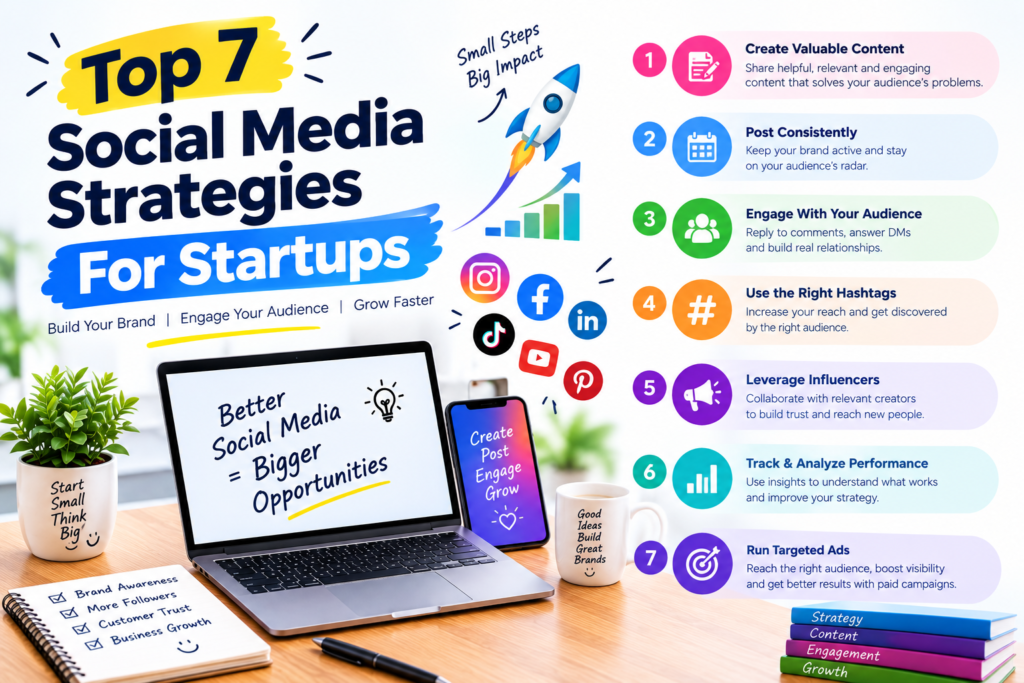
The top 7 social media strategies for startups are:
- Define your target audience
- Choose the right social media platforms
- Create valuable and consistent content
- Focus on short-form video and Reels
- Build engagement and community
- Use social media analytics
- Combine organic content with paid advertising
Start small, understand your audience, create useful content, monitor your results, and continuously improve your strategy.
For startups, social media is not just a place to promote products. It can also become a platform for building relationships, demonstrating expertise, creating brand awareness, and connecting with potential customers.
Want to build practical digital marketing skills?
DNMarketing helps learners understand digital marketing concepts through practical and theoretical learning. Start building your digital marketing knowledge and develop skills that can support your career or business journey.
FAQs
What is the best social media strategy for a startup?
There is no single strategy that works for every startup. Businesses should begin by understanding their target audience, choosing relevant platforms, creating useful content, and measuring performance.
How often should a startup post on social media?
The ideal frequency depends on the platform, audience, resources, and content strategy. Startups should prioritize a consistent and sustainable schedule rather than posting excessively.
Should startups use paid social media advertising?
Paid advertising can be useful for startups that want to reach specific audiences or promote particular products, services, or campaigns. Businesses should define their objective and monitor performance.
Which social media platform is best for startups?
The appropriate platform depends on the startup’s target audience, industry, content format, and marketing objectives. A startup does not necessarily need to use every platform.
Why is social media important for startups?
Social media can help startups build awareness, communicate with audiences, share content, develop communities, and support broader marketing objectives.